











PMMA compounds from Röhm used in Volkswagen's latest emblems

Volkswagen has recently modernized its logo in one of the world’s biggest rebranding exercises. The new logo has been reduced to its essential components and appears in a flat, 2D design.
This change is also reflected in the emblems of the current ID models, such as the ID.3: In place of chrome-colored letters on a high-gloss black background, the new brand logo is resplendent in a modern black and white high-gloss look.
It underlines the positive perception of the premium brand, especially in combination with the increase in the emblem diameter by 4.5 centimeters, making it even more eye-catching when applied to the front or rear of a car.
The combination of two PLEXIGLAS Hi-Gloss products is used by Austrian automotive supplier, Ulbrichts GmbH, to create the modern look of the emblem. The company uses special molding compounds from Röhm GmbH which has been used for black, high-gloss components in the automotive industry for almost 20 years.

The current VW emblem, as seen here on the ID.3, combines white letters and a jet-black background. Both elements are manufactured using two color variants from the PLEXIGLAS Hi-Gloss series.
This molding compound is used to create class A surfaces with very high color depth. The contrast between black and white helps the letters of the current logo clearly stand out, regardless of the paint color beneath. Volkswagen has been using this effect for several years now, albeit in a modified version. Here, the famous chrome-colored letters stand out thanks to a high-gloss black background made from PLEXIGLAS Hi-Gloss.
Whether a combination of black and white or black and chrome, the glossy appearance is retained throughout the entire life of the vehicle, as the brand polymethyl methacrylate (PMMA) from Röhm is resistant against fuels and many other chemicals, as well as UV and weather.
Before the high-gloss emblems were finalized, the European market leader for automobile emblems and lettering had to perform significant development work.
“Volkswagen approached us for the first time back in 2012 with the task of developing high-gloss emblems,” said Georg Scharpenack, CEO of Ulbrichts GmbH. “Painted components were not feasible for cost reasons, which is why we experimented with various materials.”

The covers of the illuminated emblems were made from PLEXIGLAS with an optical coating, which makes them appear even brighter.
The goal was to find a material which could be formed into thin and high-quality emblems using an automated injection molding procedure. “We initially thought PMMA was not suitable for this,” Scharpenack continued. “However, Brenntag Austria and the high-quality products from Röhm convinced us otherwise.”
Brenntag is the global market leader in chemical and ingredients distribution. Brenntag Austria is the trade partner of Röhm in Austria and therefore offers its customers the entire range of PLEXIGLAS products.
“We are aware of the strengths of the different materials - and PLEXIGLAS Hi-Gloss molding compounds also have several benefits when it comes to producing emblems,” commented Joachim Schicker, Account Manager Material Science-Polymers at Brenntag Austria.
These benefits mean it is possible to create the black and white high-gloss component with a class A surface in just one work step when injection molding. “There is no need to apply a subsequent high-gloss paint,” said Scharpenack. “We can therefore significantly reduce the costs for each component.”
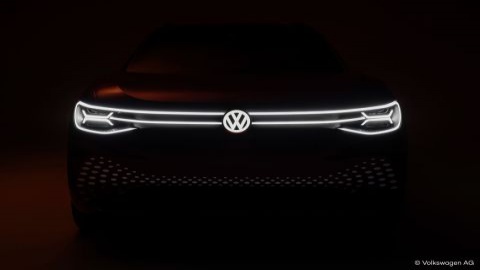
The ID.ROOMZZ concept car showed off this aspect with its particularly striking light elements and illuminated front and rear emblems. “While European legislation currently does not permit brand logos to be illuminated on the road, several Asian countries do allow it. PLEXIGLAS molding compounds are also available for this,” added Siamak Djafarian, Head of the Molding Compounds business unit at Röhm.