

















SIGMASOFT Virtual Molding optimizes cycle time with conformal cooling

SIGMA Engineering will present an example from /H&B/ ELECTRONIC created with SIGMASOFT at Fakuma 2023. The project demonstrates how the development of conformal cooling for a connector housing is enabled and optimized through simulation.
In injection molding, thermal performance of the mold can significantly influence part quality and cycle time. Temperature variations lead to different cooling rates and cause residual stresses and warping in finished part. Variation in wall thickness within the part are problematic as localized cooling requirements differ greatly.
The goal is to keep temperature consistent in order to ensure even heat dissipation. Thus, conformal cooling is increasingly being used.
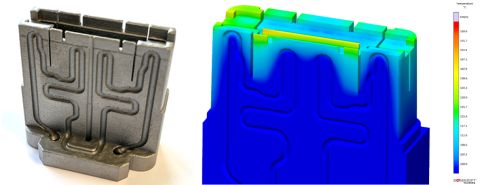
The mold insert (left) had to prove itself in SIGMASOFT Virtual Molding before manufacturing.
Simulation allows for quantifying the advantages compared to conventional concepts beforehand, including improved part quality, shorter cycle time, accurate prediction of hotspots, in order to weigh them against additional costs.
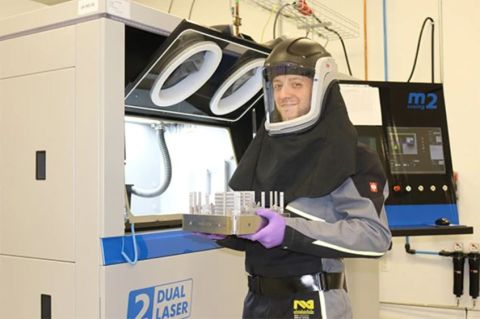
Modern metal 3D printing allows free choice of shape for mold inserts with integrated cooling. /H&B/ ELECTRONIC has designed the simulation-based layout of the 3D-printed tempering system using SIGMASOFT and successfully implemented into serial production.
“SIGMASOFT enables innovations for our customers. In the case of /H&B/, even the significant investment in their own metal 3D printer was justified,” said Timo Gebauer, CTO of SIGMA Engineering.