













(Fakuma Direct) New high-performance and sustainable chemical solutions for automotive in spotlight

At Fakuma 2023, which is well known for injection molding technologies showcase, more chemicals and materials companies strengthens their trade fair presence as more customers are eager to find out solutions for increasing integration of materials and processing.
From what can be seen, latest developments on chemicals and materials solutions in automotive application are highlighted by exhibitors, including Solvay, BASF, Asahi Kasei and Röhm, among others. The focus is high performance and contribution to e-mobility and sustainability.
Exhibitors on latest trend of plastics on e-mobility application
Correspondent editor from Adsale Plastics Network took a chance to talk to the exhibitors on the latest trend of e-mobility applications.
Some exhibitors reflected that plastics play an increasingly important role on e-mobility application due to two reasons – more safety and environmental regulations on e-mobility, as well as the different requirements of new energy vehicles, compared to traditional ones, such as flame retardant and lightweight.
As a result, suppliers of such solutions are eager to enhance the performance of plastics, in terms of safety, especially for battery, and higher mileage. In addition, with the advancement in electronic technology, interior design of e-mobility innovates, with the aim to improve entertainment experience on travelling.
Experts from Solvay also pointed out that specialty plastics of higher performance and focus, which will be increasingly adopted to e-mobility and transportation application, replacing traditional plastics.
Solvay: New polymer solutions for e-mobility
Solvay launches two new grades of Ryton polyphenylene sulfide (PPS) Supreme resins, which are produced with 100% renewable electricity. They bring enhanced performance characteristics in e-mobility applications and complement the company’s Amodel Polyphthalamide (PPA) Supreme resin launched in 2021.
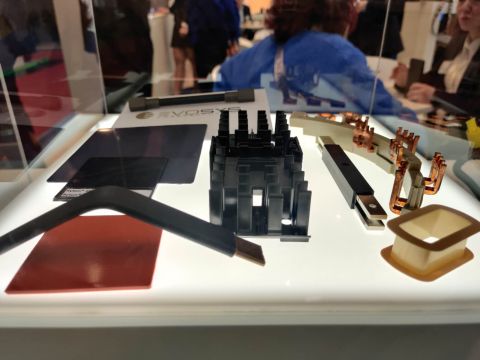
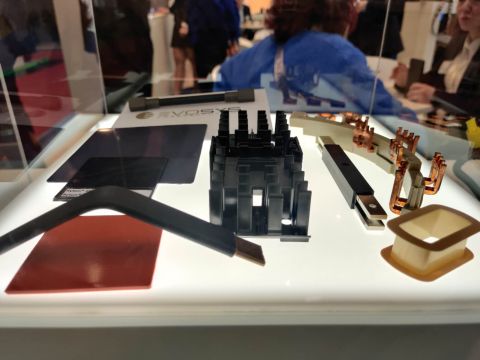
Exhibits of PPS applications from Solvay.
To address the latest battery applications requirements, Solvay also introduces a new Xencor Xtreme long glass fiber PPA solution for higher safety and reliability in thermal runaway incidents.
Xencor XTreme PPA LFG grades are produced with partially bio-based content and 100% renewable electricity. The key benefits of the materials include high stiffness, strength and impact resistance, outstanding electrical insulation with a comparative tracking index of more than 600 volts and high dielectric strength.
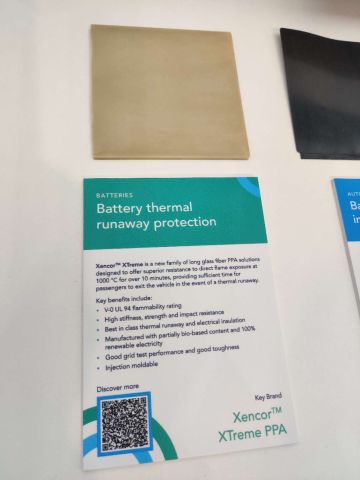
Exhibit of Xencor XTreme PPA from Solvay.
They offer superior resistance to direct flame exposure at 1000°C for over 10 minutes, providing sufficient time for passengers to exit the vehicle in the event of a thermal runaway and meeting the latest global regulations in Europe, China, the US and other countries.
The materials also retain an outstanding level of electrical insulation after exposure to flame, helping to mitigate thermal runaway in batteries. Furthermore, the material has a high glass transition temperature (Tg) which enables dimensional stability of the parts under battery operating conditions.
Xencor XTreme can be applied to battery components such as overmolded busbars, module end plates and fixtures. This unique product range enables to address challenges in terms of safety, power density, security and lightweighting.
In addition, Solvay’s new PEEK materials – KetaSpire PEEK, Ajedium PEEK and Ajedium PAEK are also presented for the first time at Fakuma’s fairground.
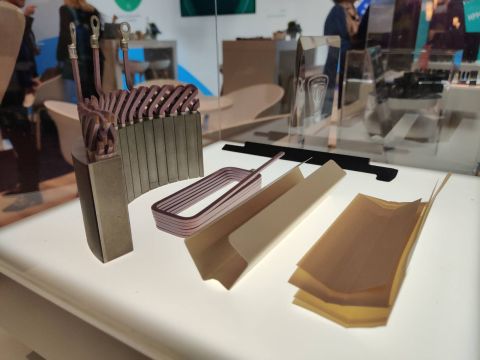
Exhibits of PEEK and PAEK materials from Solvay.
The company demonstrates the use of KetaSpire PEEK on the high voltage winding magnet wire, which delivers improved electric traction motor performance for magnet wire insulation (240°C), giving traction motors higher power density, speed output and efficiency.
With Adjedium PEEK and PAEK films, thinner and higher performance slot liners can save more space while providing superior heat transfer, significantly outperforming laminate materials and increasing power and performance.
BASF: Innovative e-mobility applications
A range of innovative e-mobility applications are showcased at BASF booth, including charging solutions, high-voltage connectors and bus bar holders, as well as with a focus of battery components meeting high performance and safety standards.
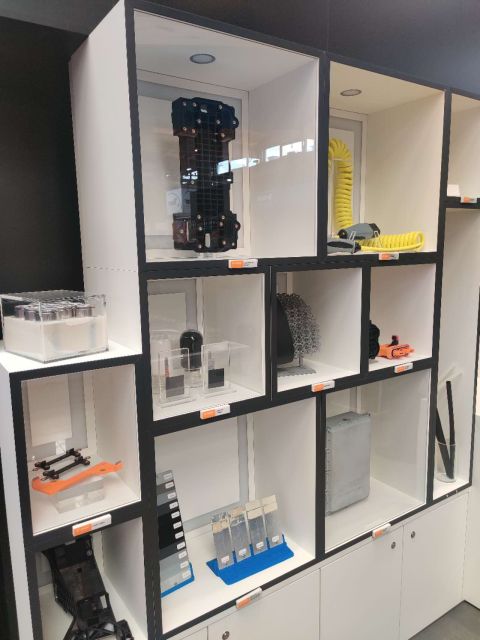
Exhibits of e-mobility application from BASF.
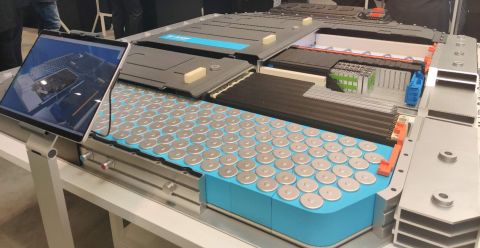
E-mobility battery demonstrator from BASF.
The company’s whole range of polyphthalamides (PPA) will be presented for its outstanding compounding capabilities, fulfilling the needs for metal replacement, constant mechanical properties at high continuous-use temperatures and color matching in e-mobility, E&E and mechanical engineering sectors.
Featuring from e-mobility orange to appliance white, Ultramid Advanced grades will be on display with features such as enhanced robustness, long-term performance and reliability in harsh conditions also of colored, flame-retardant parts.
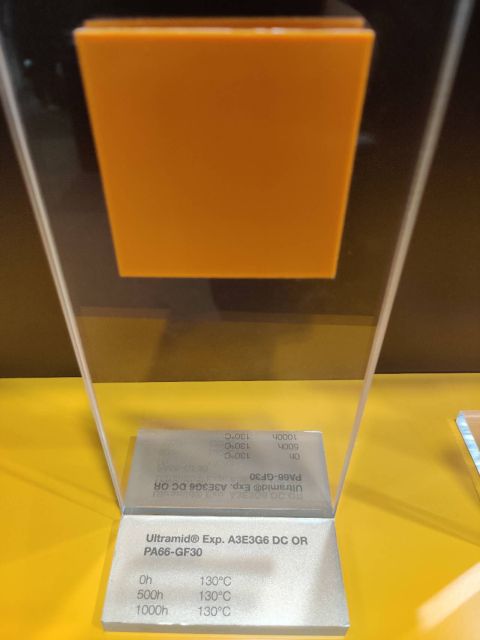
Ultramid in e-mobility orange.
In addition, BASF also exhibits Elastollan, a thermoplastic polyurethane (TPU) which is known for its resistance and performance.
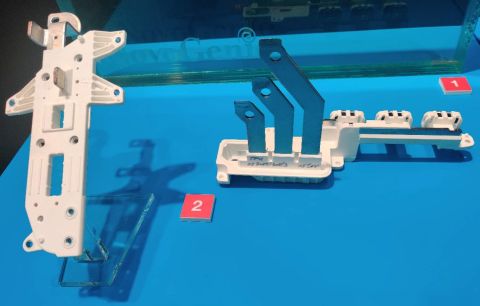
Busbar with Elastollan TPU (left) and impact resistance glass with Elastollan L (right).
Busbars, cable protection hoses, sealing lips, spring pads, haptic and surface elements in the interior and other molded parts in the car, can be benefited with use of Elastollan, which which ensure a secure flow of information and thus increase safety in the car, even in wet, vibratory and cold environments.
Asahi Kasei: Debut of GFR thermoplastic for EV batteries
Asahi Kasei’s new continuous glass fiber reinforced (GFR) thermoplastic, LENCEN, is presented at Fakuma for the first time. This composite material is formed by stacking layers of continuous glass fiber textiles with polyamide 66 (PA66) films.
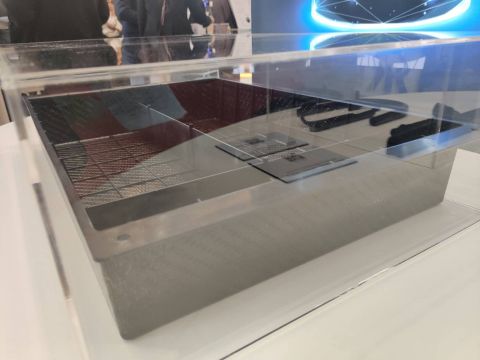
LENCEN is a continuous glass fiber reinforced thermoplastics.
With its tensile strength, high heat resistance and impact properties similar to metal, the material improves collision safety and weight reduction of EV batteries.
Asahi Kasei also presents a bio-based and biodegradable cellulose nano fiber (CNF) at the fairgrounds. This material is made from cotton linter and features high heat resistance and network-forming ability.
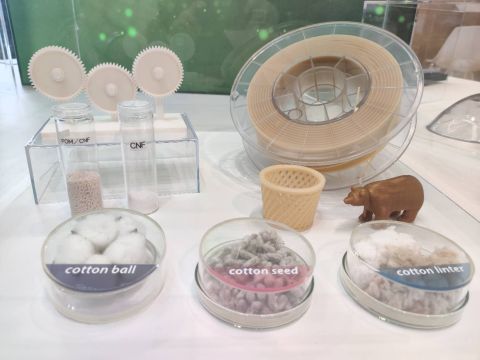
Exhibits of cellulose nano fiber from Asahi Kasei.
CNF-reinforced polyamide shows a thixotropic behavior, making it exceptionally suitable for 3D printing applications in terms of easy printing, dimensional accuracy, smooth appearance and mechanical performance. Furthermore, CNF has better material recyclability than glass fibers.
Röhm: First showcase of PLEXIGLAS proTerra molding compounds
Röhm debuts the new PLEXIGLAS proTerra molding compounds, with two different approaches, featuring a reduced carbon footprint with proven performance.
PLEXIGLAS proTerra 8N contains fossil resources that have been replaced with raw materials certified under ISCC PLUS.
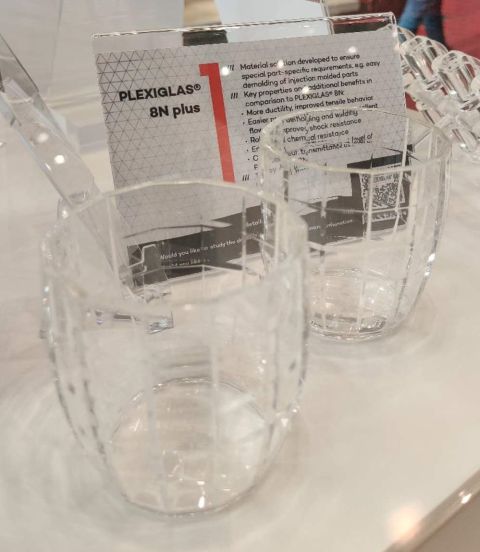
Exibits of PLEXIGLAS proTerra 8N plus from Röhm.
PLEXIGLAS proTerra 8N is a green twin of PLEXIGLAS 8N, allowing customers to switch to a resource-friendly material with identical product properties – without the need for renewed release testing.
Accordingly, the Automotive Manufacturers Equipment Compliance Agency (AMECA) has already listed PLEXIGLAS proTerra 8N as a material that complies with applicable standards.
For PLEXIGLAS proTerra M5, it contains mechanically recycled PMMA.
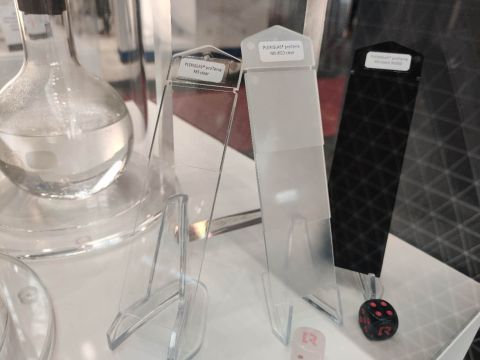
Exhibits of PLEXIGLAS proTerra M5 with different visual features.
Röhm also showcases innovative products in various sectors, including neutral gray PLEXIGLAS special molding compound in automotive manufacturing, and PLEXIGLAS 8N plus in automotive manufacturing, architecture, lighting and in household appliances.