



















A 3D-printed house takes only 48 hours to build


The Czech Republic's first 3D-printed house, in the southern city of Ceske Budejovice, took only 48 hours to build and needs a few more weeks to dry. It has demonstrated the speed and effectiveness of a construction technique, that is claimed to be seven times faster and half the cost of building a brick house.
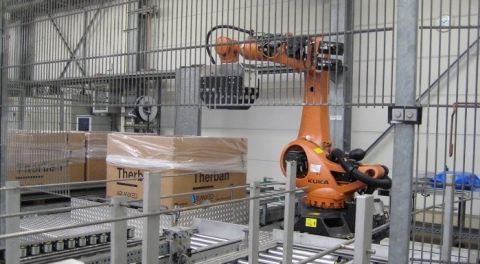
With three rooms and a floor area of 463 sq ft, the Prvok od Burinky home was built layer-by-layer using a robot arm repurposed from the automotive industry.

The 3D-printed house is built on a floating pontoon.
This arm deposited a specially formulated concrete, which was co-developed by Master Builders Solutions (BASF), with nano-polypropylene fibers, plasticizers and setting accelerators mixed in, at a rate of 15 cm per second. Walls were printed with inner and outer layers, and the middle presumably was filled with insulating material.
According to the company, this concrete set to standard house foundation hardness within 24 hours, and after 28 days it will complete its hardening to the point where it's as strong as a bridge. The structure and materials are designed to hold up for 100 years.

The house is equipped with recirculating shower.
This demonstration house is built on a floating pontoon, with a wooden deck around it. Moving inside, it's a fairly small living space for two, with a bedroom, living room/kitchen and a bathroom.
It is also equipped with the requisite eco-tech including recirculating shower, green roof, and reservoirs for drinking, utility and sewage water. This kind of structure will create up to 20% less CO2 than an equivalent brick building.