





















U.S. chemical output to fall 1.6% amid immense uncertainty in 2023, expects ACC

Following a strong year, U.S. chemical production has slowed going into the second half of this year as demand for chemicals softens and a risk of recession remains high, according to the American Chemistry Council’s (ACC) Economic Mid-Year Chemical Industry Situation and Outlook for 2023.
“The pandemic-driven rebound has subsided, and we expect consumer spending to continue to slow,” said Martha Moore, ACC chief economist and author of the Outlook. “Going into the second half of the year there is tremendous uncertainty, and the risk of recession remains high. In a soft economy, companies will be managing their inventories very carefully and keeping a close eye on the impact of regulatory policies in the U.S.”

U.S. chemistry situation and outlook
Weakness in U.S. chemicals emerged in the third quarter of 2022 and accelerated into the end of the year offsetting strong growth earlier in the year. This is consistent with the findings of ACC’s new Economic Sentiment Index that found that chemical firms felt that overall business activity and major customer demand deteriorated in the first quarter, but were expected to improve over the next six months.
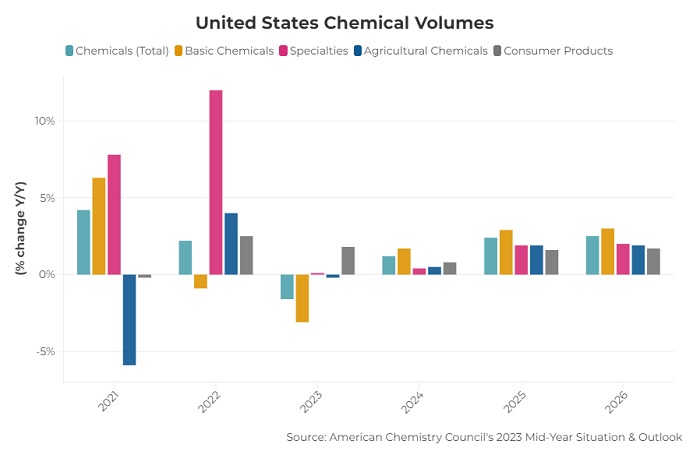
ACC expects chemical output to fall 1.6% in 2023 with lower output in most segments. In 2024, we expect a modest recovery in all segments with overall chemistry output growing by 1.2%.
Chemical industry employment surged in 2022 with the industry gaining more than 18,000 workers. In 2023, employment is expected to fall by 3,000 and by another 1,000 in 2024. Chemical workers continue to be among the highest-paid in the manufacturing sector - averaging more than US$90,000 per year.
Capital spending is expected to slow to a 2.4% gain in 2023, but then continue to expand through 2026 (averaging ~3-4%). Increasingly, sustainability investments will take a larger share of the capex portfolio.
Market drivers: Mobility and housing
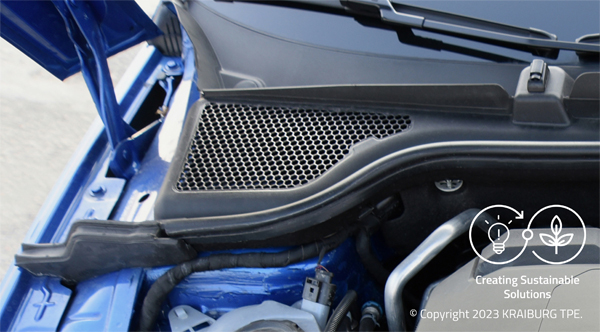
Light vehicles continue to be an important market for chemistry, with over US$4,000 worth of chemistry per vehicle. Following three years of well below average sales due to the pandemic and then semiconductor shortages, dealer inventories have been replenished.
Pent up demand for vehicles will be tempered, however, by higher borrowing costs and uncertainty. As a result, ACC expects vehicle sales to rise to 15 million this year and rise to 15.4 million in 2024. Chemistry-intensive electric vehicles will continue to increase their market share.

Housing is another important consumer of chemistry products. Following a surge of activity driven by remote work during the pandemic, the housing market was among the first casualties of higher interest rates. Housing starts fell in 2022 for the first time since the housing crisis in 2009.
With many existing home mortgages financed with low rates over the past decade, owners of existing homes face disincentives to move to new properties at higher mortgage rates. As a result, inventories of existing homes are historically lean and may provide some support for new homebuilding.
State of trade
Economic expansion in Asia/Pacific (especially India) will offset weaker GDP growth in Europe, Japan and North and South America. ACC expects global economic growth to ease into a 2.3% pace in 2023 before picking up modestly to a 2.6% pace in 2024.
With weaker growth and a global shift away from spending on goods, global industrial production growth will slow to 0.7% and trade volumes growth will ease to a 1.5% pace in 2023. In 2024, ACC expects global production and trade volumes to grow by 2.5% and 3.1%, respectively.

Keys to future growth
Moving beyond the short-term downturn, prospects for U.S. chemistry remain strong with competitive energy fundamentals and the resurgence in U.S. manufacturing from once-in-a-generation legislative initiatives to promote clean energy, infrastructure, and a strong domestic manufacturing base.
To boost U.S. competitiveness and move production back to America from places like China, ACC suggests to manufacture and move more chemicals in America. Doing so is critical to supporting national priorities, including energy independence, and competing with other countries in critical technologies, such as producing world-class semiconductors and batteries, components, and infrastructure for electric vehicles.