
















Safer EV: Thermal barriers expanded to 3D variants for slowing down thermal runaway

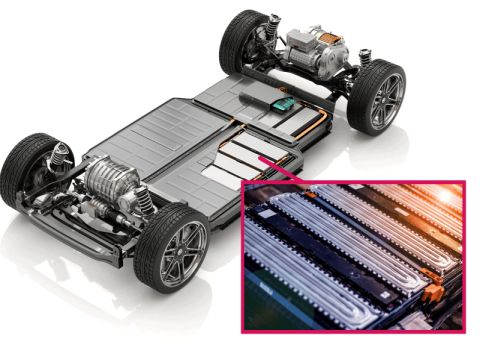
Freudenberg Sealing Technologies has developed thermal barriers for electric vehicles (EVs) that slow down thermal runaway by increasing thermal propagation resistance, which are also available in 3D variants now.
Thermal runaway, the ignition or explosion of battery cell caused by a self-reinforcing heating process, is a major safety problem for EVs. It can be caused by both internal and external factors, including overcharging, excessive discharge, damage or heating of battery.
Thermal runaway releases not only flames and hot gases, but also electrically conductive particles. These in turn can cause thermal propagation in adjacent cells and lead to short circuits in electrical system.
Thermal barriers act as protective layers that can slow down or even prevent the heat and flames from spreading in the battery, which significantly increases safety.
Entirely new possibilities
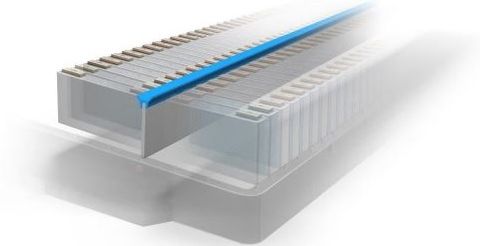
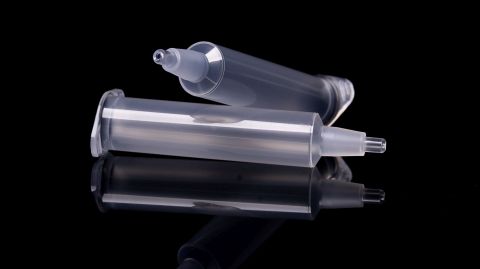
Beyond the existing two-dimensional barriers, such as flat mats and thermal blankets, customer-specific and 3D variants with lightweight feature can be manufactured by high and low volume manufacturing processes, such as injection molding and continuous extrusion.

3D thermal barriers serve as protective layers in batteries.
“What is completely new is that the thermal barriers are now also available in customized, flexible 3D geometries, which makes it possible to use them in various positions within the battery and allows for integration of additional components,” said Andrew Espinoza, Global VP Technology of the Oil Seals Powertrain & Driveline Division.
The company currently produces a few products, including profile seals, module separators and covers, including those for bus bars, cooling lines or electrical components.
Specific insulating materials developed
Freudenberg’s material experts have developed heat-resistant, electrical and thermal insulating materials specifically for these applications. The 3D thermal barriers use elastomer solutions, either in solid form or as a foam, and plastic components such as Quantix Ultra, which enables complex geometries.
These compounded polymers have been proved to safely withstand temperatures of up to 1,200°C. The special composition also makes the materials resistant against particle impacts, such as those that occur when cells are vented.
“The products meet the highest quality standards, are certified pursuant to UL 94 V-0 and are already being used successfully in initial series production for the automotive industry,” added Andrew Espinoza.