













Report: Potential bottlenecks in Li-ion battery supply chain

Global Data, a leading data and analytics company, presented the latest thematic report “Batteries – Thematic Intelligence” which identifies key trends impacting growth of the theme over the next 12-24 months.
Industry revenues to increase rapidly
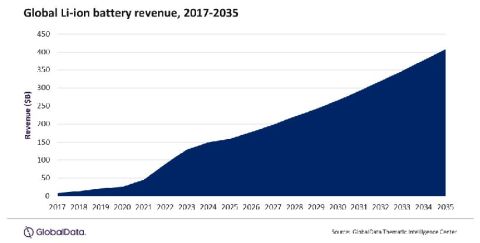
The report forecasts the Li-ion battery industry revenues to increase at a compound annual growth rate of 12.5% from $88.6 billion in 2022 to $408.3 billion in 2035.
The expected revenue expansion will be driven by sales of Li-ion batteries for mobility end uses, alongside with considerable YoY growth in consumer electronics and energy storage.
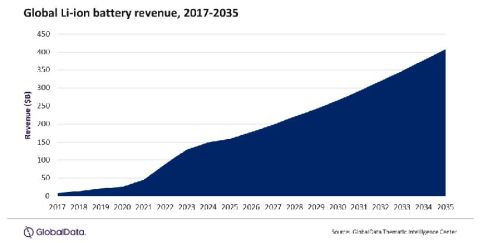
Data on revenue and prediction of global Li-ion battery from 2017 to 2035.
Lack of suitable raw materials the major threat
The report also identifies potential bottlenecks in the supply chain. As a crucial element in the development of EV batteries, raw materials will be a leading factor affecting governments worldwide on decarbonizing their economies.
Thomas Pothalingam, Thematic Intelligence Analyst, pointed out that the biggest threat to supply security is the lack of low-cost and easy-to-purify raw materials to feed existing battery gigafactories.
Demand for cheap, safe, high-performance, long-lasting and low-carbon-footprint batteries will soar in the next 10 years, especially from the automotive industry.
Geopolitical factor pushes local battery recycling
Furthermore, China’s control of the entire global supply chain, from mines and refiners to component markers and cell producers, is a mounting geopolitical issue. The US and Europe are taking significant steps to reduce the dependence on China within their battery supply chains by 2030.
“It will radically reduce the dependence on mined materials and the ecologically dirty mining industry. The US, Europe, and China are all embarked on developing their own local recycling industries, with Norway in the vanguard,” explained Pothalingam.
Battery recycling is hugely affected by geopolitics as much as environmental sustainability. The circular battery economy will be critical to the energy transition, nations and companies must develop domestic recycling.
“Employing recycled materials reduces the dependency on issues such as mining output, ore grade, regional export quotas, geographic and political monopolies, and other unpredictable factors that make the market volatile,” continued Pothalingam.
He also added that recycled minerals reduce the environmental impact of mining and product development, which is an important factor to consider regarding emissions disclosure rules and access to green finance.
Market domination limits technological innovation
Major companies, including CATL, BYD, LG Energy Solution, Panasonic, Samsung SDI, and SK Innovation, are predicted to dominate the battery market in mid-term.
The companies control nearly 90% of global production and are forming close ties with the top dozen or so auto companies that are becoming progressively more vertically integrated structurally.
The industry’s consolidation limits the potential of startups to technological innovation, the report warns.