
























Arkema further reduces carbon footprint of bio-based polyamide 11 grades

Arkema further decreases the carbon footprint of its bio-based Rilsan polyamide 11 grades by 46%, reaching less than 2kg CO2e/kg, with use of renewable or low carbon energy sources. It represents an improvement of around 70% relative to traditional polyamide resins using fossil-based raw materials and conventional energy sources.
Rilsan polyamide 11 is derived entirely from renewable castor seeds and is 100% segregated bio-based. Furthermore, the amino 11 monomer and the downstream polymers are produced using a significant proportion of low carbon and renewable energy, in terms of both electricity and combustible fuels.

Rilsan polyamide 11 is entirely derived from renewable castor seeds.
The company thus recently announced a biomethane supply agreement with ENGIE in France. It also carried out several energy efficiency improvements in its polyamide 11 chain production sites over the last year.
Arkema’s commitment to ever-lower carbon footprint and lower climate change impact is affirmed through the company’s target to reduce the carbon footprint by a further 50% by 2030.
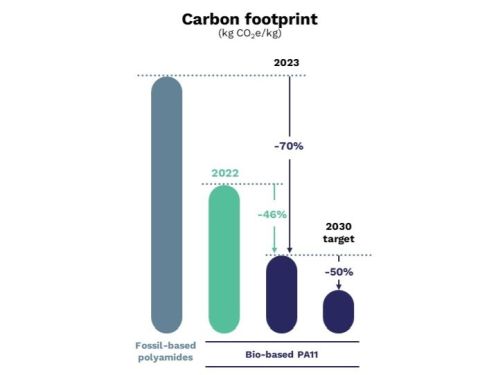
The graph shows Arkema’s plan to reduce carbon footprint of Rilsan polyamide.
“The lower carbon footprint we announce today applies to our entire global production, not just a particular set of grades or a certain location. This allows our customers to deliver on their commitment to decarbonize and to develop more sustainable products at scale,” explained Erwoan Pezron, Senior Vice President.