
















(Fakuma Direct) KraussMaffei demos MuCell technology with new screw at Fakuma

Patented technology, MuCell, is fully capable of generating savings on material, energy and investment costs. Nevertheless, the technology has not widely adopted yet for intricate visible parts. In view of this, KraussMaffei and its partners conduct demonstration on an all-electric PX 321-1400, with a highlight on the new universal screw, at Fakuma 2023.
Spotlight: MuCell with new universal screw
Created for MuCell, KraussMaffei’s new HPS-Physical Foaming screw with a longer three-zone area can be universally used for all plastics (with and without fiber reinforcement) and has a plasticizing capacity that has increased by up to 30%.
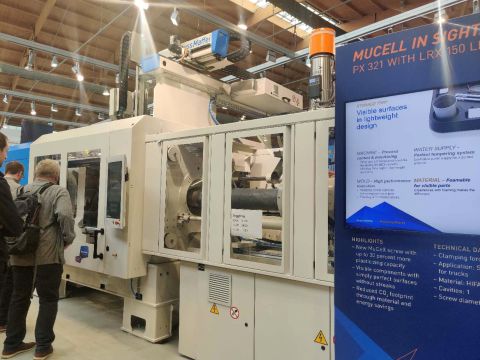
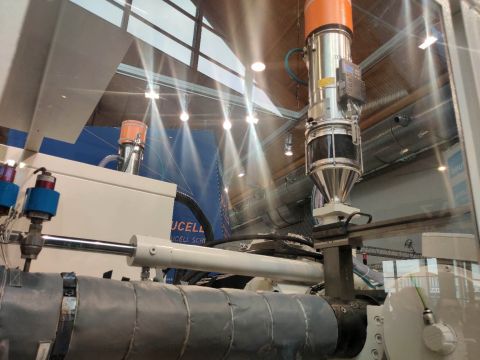
All-electric PX 321-1400 MuCell with new universal screw and 30% higher plasticizing capacity.
This allows lesser screw diameter than before, which significantly reduces investment and operating costs for the plasticizing unit, or generates greater output using a screw of the same size as before.
For the first time, the APCplus machine is also used with a gas-charged melt. The machine shifts the changeover point and the holding pressure profile from shot to shot based on the measured melt viscosity, resulting in extremely weight-constant components.
Machine demonstration featuring partnered technology
The all-electric machine demonstrates its application, a storage table for trucks and commercial vehicles, featuring a list of technical highlights on physical foaming.
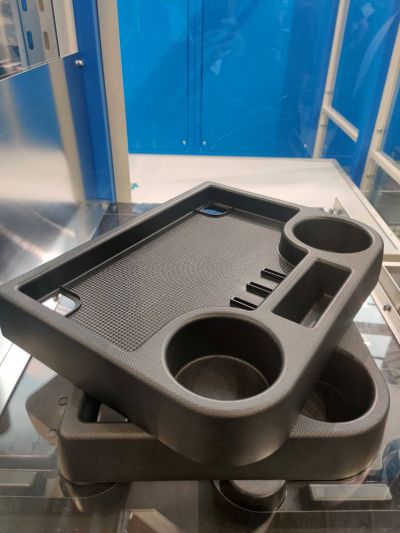
PX 321-1400 produces a storage table for trucks in four different designs at Fakuma.
KraussMaffei and its partners demonstrate their expertise on this application. To begin with, Austrian company, Isosport, supplies a suitable film for surface decoration by in-mold labeling (IML), which prevents the formation of bubbles by the outgassing nitrogen.
Wirth Werkzeugbau from Germany leverages all its skill in the mold, for instance, the opening stroke allows maximum possible degrees of foaming. With the company’s expertise, immersion edges are excluded, which are usually required for the process.
For molds for MuCell, precise cooling is particularly important to prevent post-blow effect, which makes bubbles emerge on the surfaces after the process, while the melt in the interior of components is still hot, and renders the part unusable.
In the application showcase, special mold cooling channels ensure uniform cooling at the surface, without variothermal technology, and safely prevent hot spots.
Graining by Reichle from Germany makes a crucial contribution on achieving perfect exposed faces on the foamed components. Lyondellbasel also supplies polyolefins in the visible area of foamed components for the streak-free surface aesthetics.
Machine-side temperature control system, Orca, by Jurke Engineering, measures the speed and quantity of the flow, by ultrasonic means, from the outside and without contact with the medium. This precise temperature control optimizes the cycle time.
A metering system from Trexel is fully integrated into the KM MC6 control system and consequently ensures easy and intuitive handling. If necessary, even satellite solutions are offered that allow multiple machines, all fully integrated, to be supplied with the necessary gas using only one compressor.
Linear robot with sophisticated automation
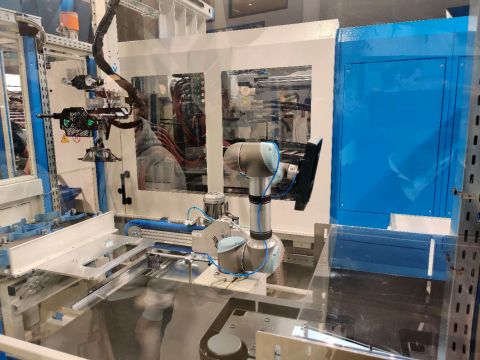
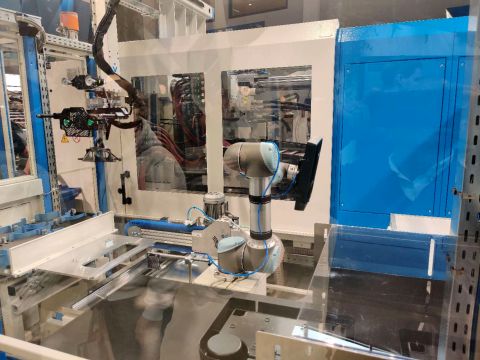
An LRX 150 linear robot from KraussMaffei picks up the blank film from a drawer in which four different film types can be kept close at hand. The robot then puts down the selected film on the cleaning station.
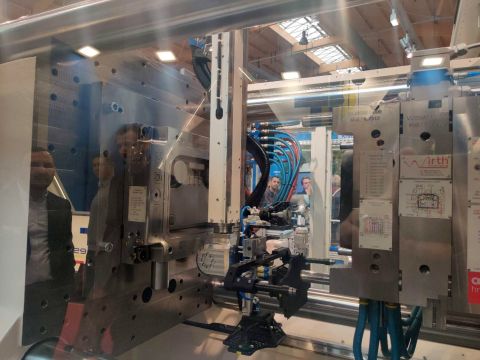
LRX 150 linear robot removes the finished part.
A cleaning brush from Wandres, Germany, and matching extractor system from ESTA, Germany, removes all particles and contaminants on the film. Concurrently, the robot gripper executes a turn so that clean suction devices pick up the cleaned film.
After that, the “stack gripper” inserts the film into the mold, and the finished part is demolded.
The demolded part is handshake transferred to a second robot for a foam structure test with a testing system from Teratonics, France. It specifically allows visualization of the compact outer layers and the spatial distribution of the MuCell foam in the interior of component, and assessment on the production as free of bubbles.
After this test, the component is placed on a conveyor belt and transported out of the automated system.