




















(Fakuma Direct) Latest advanced quality control systems on stage

Modern plastics processing machinery is developing to be more advanced and automated, so is the inspection and measurement equipment, for meeting the higher requirements of products. Quality control systems providers thereby showcase their latest solutions at Fakuma 2023.
SIKORA showcases systems for pellet purity and tube dimension
SIKORA presents its solutions for quality control in the hose, tube and pipe as well as plastics industry at the company stand.
The modularly developed PURITY SCANNER ADVANCED demonstrates how to reliably sort plastic material. In addition to optical 25 µm high-resolution cameras, which detect black specks and discolorations, an X-ray camera ensures the detection of metallic contamination.
Instead of using two optical cameras in common systems on the market, the SIKORA system features a third camera for higher detection rate, so that more contamination is detected.
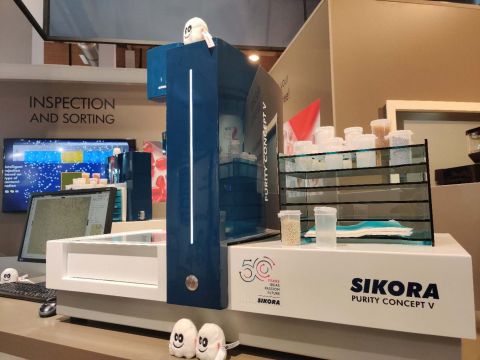
At the SIKORA stand, visitors are invited to bring samples to be tested with the inspection and analysis system PURITY CONCEPT V free of charge. They can inspect and analyze small quantities of crystalline and amorphous pellets, flakes or test plates for contamination.
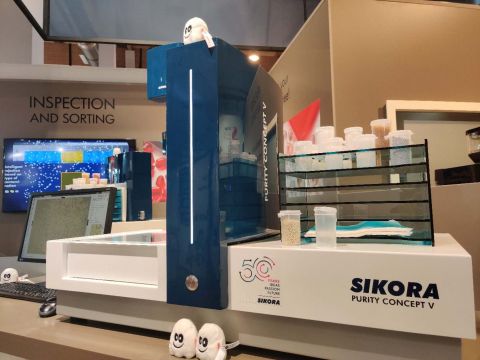
PURITY CONCEPT V is suitable for reproducible laboratory applications and detects black and colored contamination.
The system is suitable for reproducible laboratory applications and detects black and colored contamination from a size of 50 µm as well as discolorations. Analysis takes less than a minute, including test certificate and HSV color chart of the detected color deviations.
In the area of extrusion, SIKORA presents the CENTERWAVE 6000/250 for the real-time measurement of tubes in the diameter range from 32 to 250 mm during production based on millimeter wave technology.
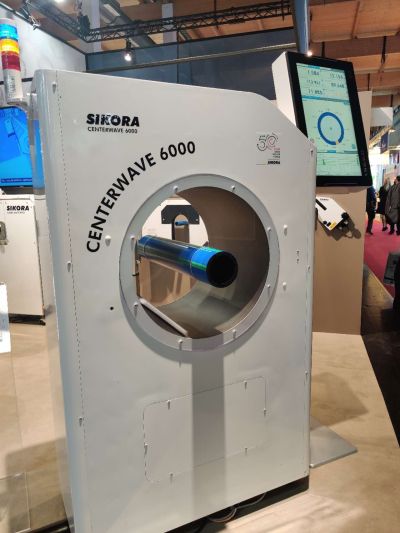
The CENTERWAVE 6000/250 is the small size of the series.
In the line, the system enables gapless, reliable quality control as well as automatic control. The model is characterized by its simple operation. At the push of a button, the operator immediately receives continuous and precise measured values, without presetting the product parameters, without the influence of a coupling medium and without any calibration.
OCS presents film line and systems for polymer property measurement
OCS Optical Control Systems, a German provider of quality assurance solutions in polymer and petrochemical industries, presents its Cast Film Line for property measurements of polymers.
The Cast Film Line is used to perform optical and physical property measurements of polymers in the production of high-quality cast films, including process of extrusion, cooling, stripping and winding.
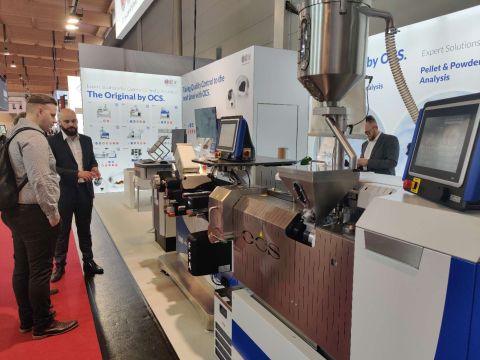
OCS Cast Film Line at the stand.
All settings and parameters, such as extruder speed, temperature, film tension, winding force and winding diameter, are stored by a touch panel control system that guarantees the film quality can be reproduced at any time.
This is important for optical and physical online/offline measurements, for example in detecting gels, contaminations, degradations and other impurities as well as haze, gloss, density and additive measurement.
Polymers that can be tested by the OCS Cast Film Line include PP, PET, PC, HDPE and LDPE, and the testable materials are pellets, powder and flakes.
The measuring extruder (ME) is equipped with a flexible height adjustment (infusion position) and the ME can be brought into a maintenance and cleaning position by an electric motor.
The modular architecture of the film analyzer (MFA) allows easy adaptation of additional measurement and testing equipment.
In addition, OCS displays the Pellet Scanner (PS25C) and the Pellet Size and Shape Distribution System (PSSD).
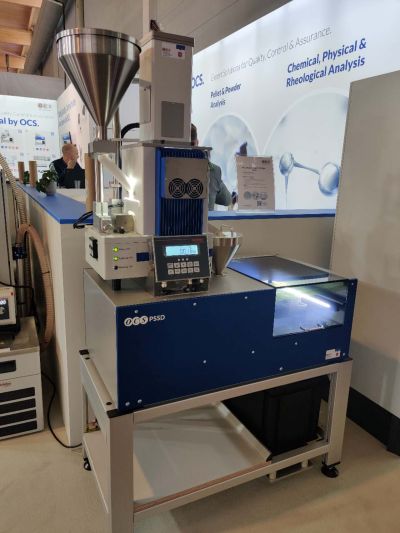
PS25C and PSSD systems are compatible.
With the PS25C, highly transparent and opaque pellets can be analyzed on a vibration plate using a high-performance matrix camera. The system detects impurities that show a color deviation. Smallest detectable contamination size is 10 µm. A multi-track flap system for sorting out contaminated pellets is optional.
All types of pellets can be analyzed in free fall using a line scan camera with the PSSD, which classifies pellets (over- and undersize, abrasion, agglomerates, etc.) according to their morphological properties. Smallest detectable size is 70 µm.
Real-time results can be visualized for PS25C and PSSD systems.