












(Interview) Technical details you should know about WITTMANN’s game-changing DC technology

One of the latest innovation that caught Adsale Plastics Network editor’s attention at Fakuma 2023 fairgrounds was WITTMANN BATTENFELD’s new conceptual machine model EcoPower 180/750+ B8X with a modified WX142 robot from WITTMANN, which draw power supply solely from a solar battery as DC voltage source. (Video:
Wittmann Battenfeld debuts conceptual DC powered injection molding machine)
The WITTMANN’s technology is a potential game changer amid spikes in energy prices and calls for carbon neutrality. It powers injection molding machines with direct current (DC) network without transforming to alternating current (AC) power, offering the benefits of energy efficiency enhancement as wells as material and carbon emission reduction.
Our editor talked to Mario Bruckner, Area Sales Manager at WITTMANN BATTENFELD, and Rüdiger Junghans, CSO from innovenergy, in an onsite interview to discover the technical details that brought the breakthrough idea to life.
Modifications made on the machine and robot
WITTMANN BATTENFELD unveiled the conceptual study of how direct current generated by solar cells can be used effectively for running injection molding equipment directly without first passing through inverters at K 2022. After a year of further development, the company demonstrated the technology on the conceptual machine at Fakauma 2023.
Some modifications undoubtedly had to be made on the machine and robot. What were these modifications?
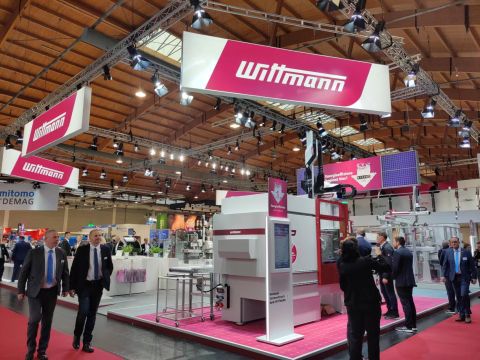
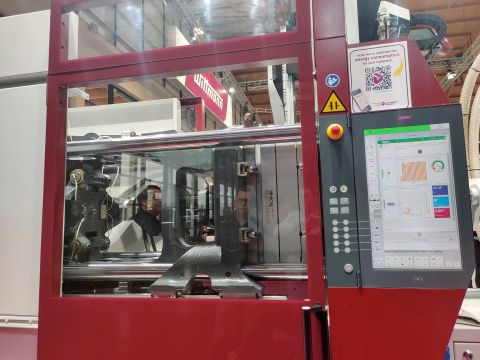
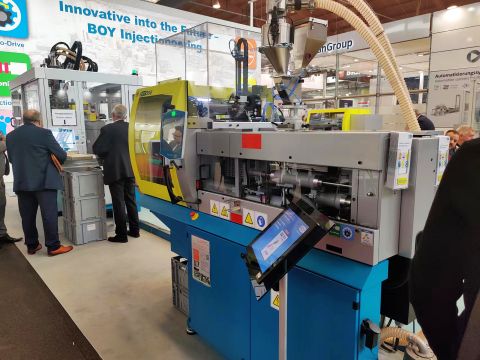
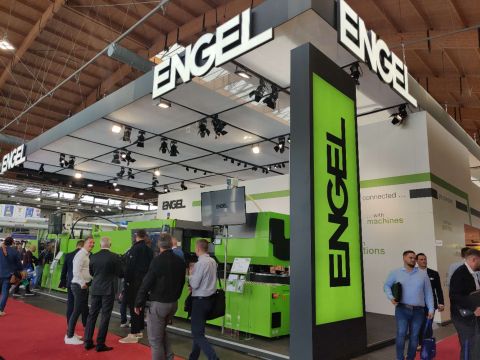
The EcoPower 180/750+ B8X demonstrated innovative DC technology at WITTMANN’s stand.
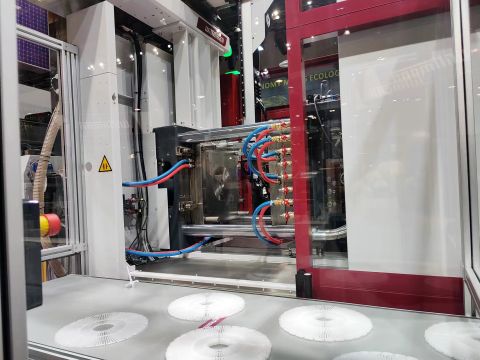
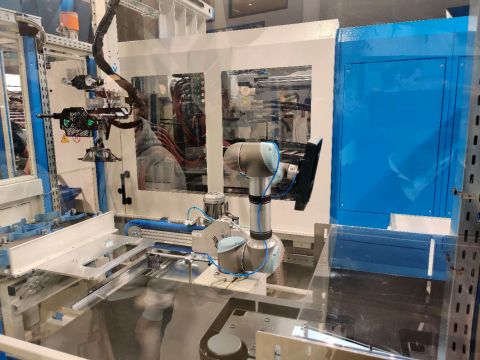
With a single-cavity mold, the conceptual machine produced drainage bodies, which were removed by the WX142 robot in DC version.
“We adapted some components in our control cabinet to DC technology. These included protective devices, main switches, fuses, cables and others, as well as software adaptations,” explained Bruckner.
“We had a power supply module specially developed by WITTMANN for our drive system in order to be able to operate the machine with direct current,” he added. Here, the rectifiers were removed, the precharging for the DC link and the filtering were adapted.
For the robot, the power supply module was removed. The DC intermediate circuits from the machine and the robot were connected. By removing the braking resistors, entire braking energy in the machine can be fully used.
The company also integrated an energy measuring system for DC into the machine and the robot. The battery charge level can be recorded and displayed on the control or centrally on a computer. The whole machine runs via the energy monitoring system IMAGOxt.
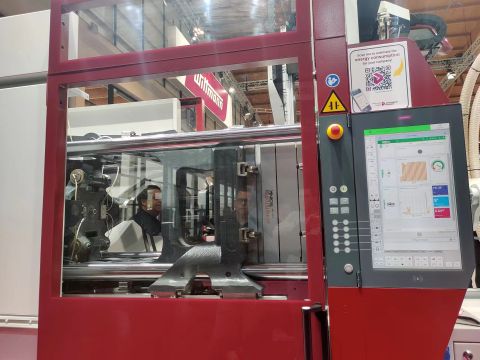
The energy level of the machine and the robot can be monitored via IMAGOxt.
High-performing and sustainable salt battery
The conceptual machine at Fakuma remained disconnected from the main network of the exhibition hall. It was powered independently via a solar power storage battery with salt battery technology supplied by partner innovenergy, which also deals with the design of DC grids.
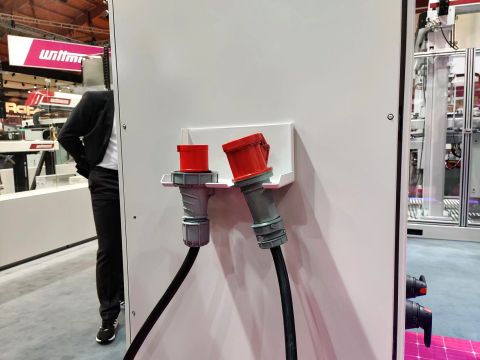
The conceptual machine remained disconnected from the exhibition hall’s AC network during Fakuma 2023.
According to Junghans, the sustainable salt battery system brings a list of benefits, including non-flammable characteristic and no additional construction in the building. It is long-lasting, maintenance-free, can be operated under extreme temperatures and can be deep-discharged without damage.
Furthermore, the system is made of harmless materials and can be 100% recycled, echoing WITTMANN’s commitment to sustainability.
“The capacity of the batteries depends primarily on customers’ requirements, for example, how long operation is to be maintained in the event of a grid failure. Then there is the issue of peak shaving to smooth out expensive load peaks,” said Junghans. “You have to look at the system in detail and determine the requirements.”
Higher energy efficiency with reduced conversion and materials
For the structure of a frequency converter for variable-speed drive systems, the first component installed is a rectifier that converts the alternating current from AC to DC in a DC link to form an alternating current with a higher or lower frequency to realize the different speeds for various machine axes.
When using DC directly, the first conversion stage – the rectifier – can be omitted. This implies that the conversion loss between AC and DC is eliminated. Battery storage systems that work with direct current eliminate such conversion loss as well. Resources such as semiconductor components and circuit boards can also be saved.
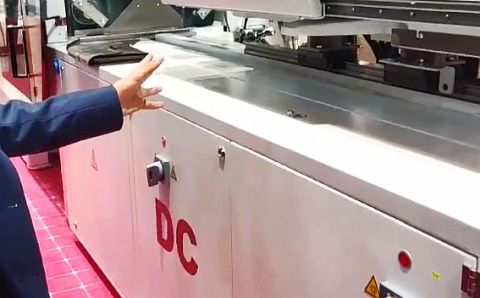
The rectifier converting the alternating current from AC to DC for variable-speed drive systems can be omitted if direct current is used.
“We are seeing a clear upward trend in alternative energy sources such as photovoltaic systems. The majority of these sources produce direct current. Therefore, the most efficient way is to use this direct current directly to reduce the conversion losses between DC and AC. In the same way, battery storage systems work with direct current,” said Bruckner.
Since DC networks use a 3-wire system (+, -, ground) but not a 5-wire system (L1, L2, L3, N, ground), up to 50% copper and 25% insulation material can be saved in the cabling for the same power.
Besides, the elimination of braking resistors makes it possible to use the entire braking energy in the system. During braking, the electric motors work as generators.
Bruckner explained that the patented Kinetic Energy Recovery System (KERS) has been used in WITTMANN BATTENFELD’s injection molding machines for a long time, which utilizes braking energy for all system components in the machine.
Also worth mentioning is the advantage of eliminating reactive and distortion power in DC grids, it results in simplified filtering and no expensive reactive power compensation.
Initial measurement shows that, with the robot, energy savings of up to 18% are possible by using the braking energy under full load. Meanwhile, the energy efficiency is improved by reducing the conversion losses in the injection molding machine by about 3%.
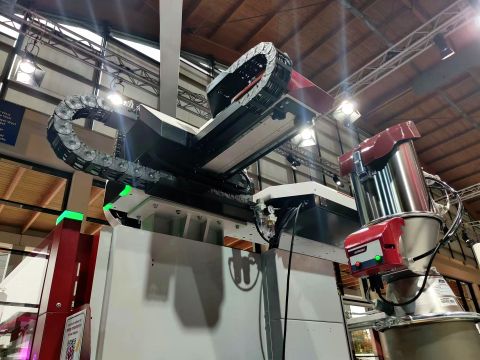
With the robot, energy savings of up to 18% are possible by using the braking energy under full load.
When considering the entire system in DC operation, energy savings of up to 15% is possible. In addition, costs can be significantly reduced through peak shaving. The exact savings depend on the electricity contract of the grid provider.
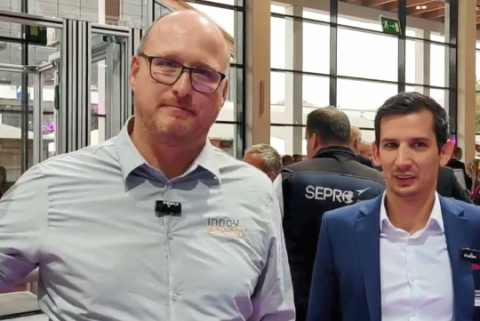
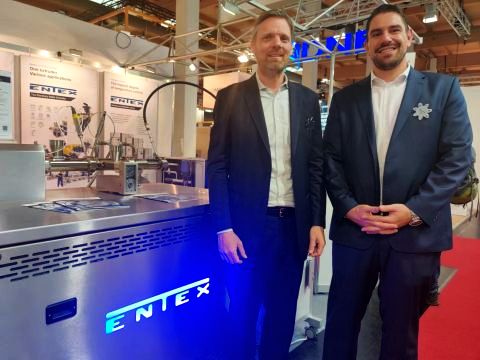
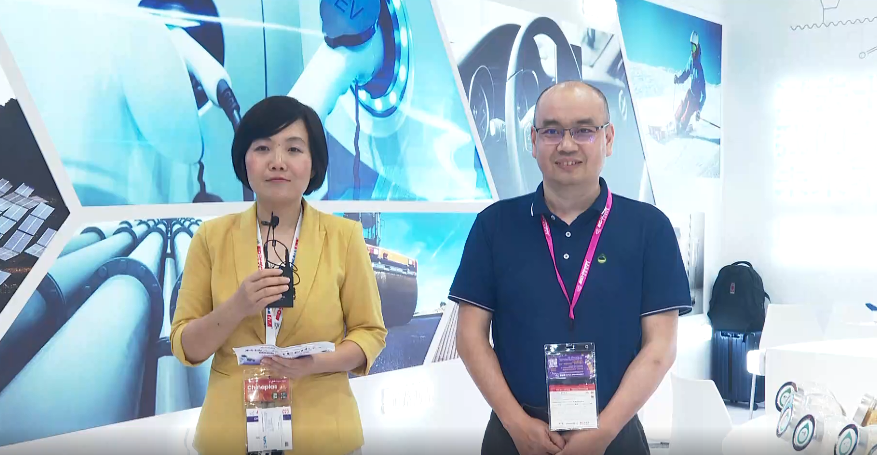
(Right) Mario Bruckner, Area Sales Manager at WITTMANN BATTENFELD, and Rüdiger Junghans, CSO from innovenergy.
DC technology in the future
The EcoPower 180/750+ B8X on stage is a conceptual machine, when will WITTMANN officially introduce the technology to the market?
Depending on how further development goes, the company expects a sales release in the 3rd quarter of 2024. “At the moment, we have focused on the EcoPower 180/750+ B8X for development work and gain experience. In general, the technology can be scaled up as in the AC world,” concluded Bruckner.
It is noteworthy that sharing the same vision of promoting DC technology and bringing it to the market, the Open Direct Current Alliance (ODCA) has been founded in Germany. The alliance continues to grow and has 54 partners now, familiar names include ABB, Audi, BMW, Fraunhofer Institute, innovenergy, KEBA, KUKA, Schneider Electric, Siemens, Stäubli, etc.